In this short lesson, we are going to learn how to construct the modes of the melodic minor scale and how to utilise them in our improvisational playing. These modes are a wonderful gateway to producing melodic lines that sound musically interesting and sophisticated. They also aid us when soloing over common but dissonant harmonic content, for example: altered dominant seventh and half-diminished seventh chords.
What are melodic minor modes?
The first step is to make sure you have a concrete understanding of the melodic minor scale. This scale is unique because it ascends differently to how it descends. On the way up, you have a natural minor scale but with a raised 6th and 7th. You could also describe this as a major scale with a flattened 3rd. On the way down, you simply have the natural minor scale.

However, when constructing melodic minor modes, we are solely concerned with the ascending scale. This is the scale that can then be manipulated to create the other modes.
The construction of these modes is identical to that of the major modes (Ionian, Dorian, Mixolydian etc.). You start with your seven-note scale and then you create the seven modes by starting on each of the other notes. The image below shows how you create the modes by using C melodic minor as your initial scale. Once you’ve mastered playing through these, you can then replicate this with the other (ascending) melodic minor scales (C# melodic minor, D melodic minor etc.).
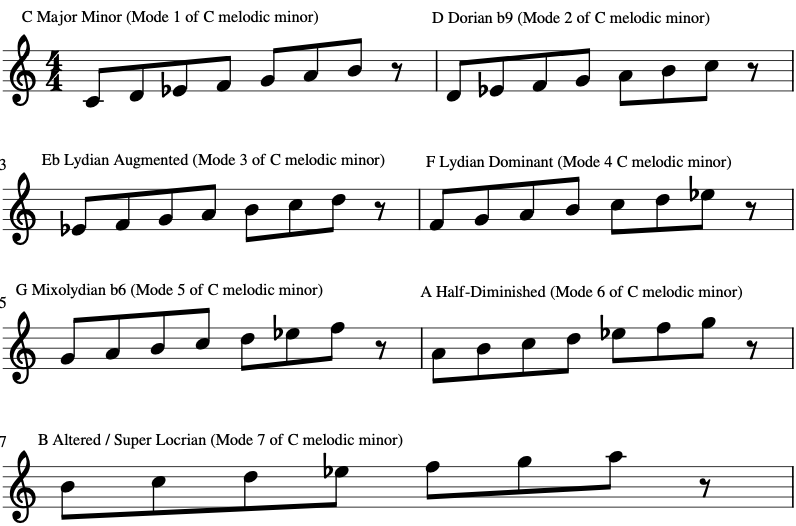
Despite the fact that this is the correct method to learn the construction of these modes, the most effective way to utilise them in your playing is to think of each scale as its own entity based on the first note, rather than a mode of its respective melodic minor scale. For example, rather than thinking of D Dorian b9 as ‘mode 2 of C melodic minor’, simply internalise it as D Dorian with a flattened 9th (or 2nd) degree. This will help you hear the fundamental characteristics of each scale more clearly and will also speed up the process of calculating which scale to use whilst improvising.
How to use the modes in jazz improvisation
There are two common ways you can utilise these modes in your playing:
- To embellish simple harmony
- To help navigate harmony with more complex extensions
Let’s begin with using the modes to embellish simply harmony. The classic, diatonic way to improvise over a 2-5-1 (e.g. Dm7 – G7 – Cmaj7) is to use Dorian – Mixolydian – Ionian. However, why not use alternate scales that add excitement through dissonance? For example, over a Dm7 chord you could use D Dorian b9 and over a G7 chord you could use G Lydian Dominant. Both of these scales encompass the necessary chord tones whilst also introducing non-diatonic notes for added sophistication.

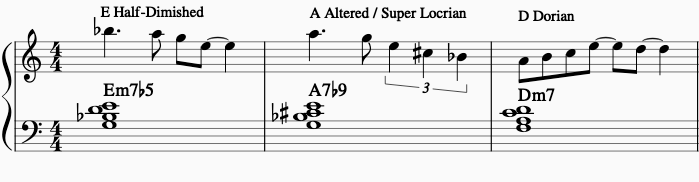
Now let’s say you need to improvise over a typical minor 2-5-1, for example: Em7b5 – A7b9 – Dm7. This is where your knowledge of melodic minor modes becomes crucial. For the Dm7 you decide to stick with D Dorian, but what about the Em7b5 and A7b9? As a general rule, improvisers tend to use the Half-Diminished scale when dealing with m7b5 chords and the Altered / Super Locrian for altered dominant chords (i.e. 7b9, 7#9, 7#5#9). The reason for this is because these scales highlight the chord tones of the harmony.
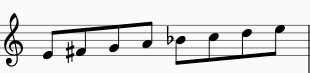
For example, the diagram below shows the E Half-Diminished scale (also known as the 6th mode of G melodic minor). You will notice that all of the notes featured in an Em7b5 chord (E-G-Bb-D) also feature in the scale.
With this now in mind, you may choose to solo over a Em7b5 – A7b9 – Dm7 as such:
Learning the melodic minor modes may take some time as they could be uncharted territory for you. Unfortunately, they are rarely discussed in music education, particularly compared to the major modes. Nevertheless, once they have been internalised and you begin applying them instinctively and musically, you will hear a tremendous improvement to your playing. Bring these out at your next jam session and it is guaranteed your fellow musicians will ask you to explain what you just did.
 Music Omnibus