Understanding jazz terminology is by no means a simple task. Learning how to read, comprehend and execute progressions like Cmaj7 – C#dim7 – Dm9 – G7#5 may appear daunting, however this article will provide you with all necessary information for 1) constructing jazz chords and 2) understanding their corresponding symbols. This is the first and imperative step in any jazz musician’s journey as it sets the foundation for the music you are seeking to play or compose. By the end of this article, you will be able to confidently understand and play any chord that comes your way.
Step 1 – 7th Chords
The first thing to understand, particularly if you’re coming from a classical background, is that the basic chord in jazz is a 7th chord, not a triad. There are six types of 7th chords you need to know:
Major 7th Chord – A major triad with an added major 7th above the root.
For example: C major 7 = C E G B
Chord symbol: Cmaj7, CM7 or C∆7
Minor 7th Chord – A minor triad with an added minor 7th above the root.
For example: C minor 7 = C Eb G Bb
Chord symbol: Cm7, Cmi7 or C-7
Dominant 7th Chord – A major triad with an added minor 7th above the root
For example: C dominant 7 = C E G Bb
Chord symbol: C7
Half-Diminished 7th Chord – A diminished triad with an added minor 7th above the root
For example: C half-diminished 7 = C Eb Gb Bb
Chord symbol: Cø7 or Cm7b5
Diminished 7th Chord – A diminished triad with an added diminished 7th above the root
For example: C diminished 7 = C Eb Gb Bbb (A)
Chord symbol: Cº7 or Cdim7
Augmented 7th Chord – An augmented triad with an added minor 7th above the root
For example: C diminished 7th = C E G# Bb
Chord symbol: Caug7 or C7#5
It is imperative that you are comfortable with these six types of chords on every root note. Once you understand this, you have mastered the basis of what jazz is. Have a look at the examples below showing more types of these chords.

And remember, there are multiple ways to ‘voice’ a single chord. Take a look at the examples below showing three ways to voice the same chord.

Common jazz voicings for all types of chords will be discussed further throughout the Jazz Harmony series.
Step 2 – Further Extensions
9ths, 11ths and 13ths
Jazz harmony is very rarely constricted to that of 7th chords. You’re more likely to hear extensions above the 7th, some of which remain diatonic and some of which stray into notes from other keys.
The most important step is to understand what is meant by a 9th, 11th and 13th. If you take the scale of C major, you can number the notes 1 – 8.

If this scale is expanded beyond the first octave, the notes remain the same but the numbers keep rising up to 15 (2 octaves above the initial C).

Therefore, when we say the 9th, in the key of C, we mean the note D.
When we say the 11th, in the key of C, we mean the note F.
When we say the 13th, in the key of C, we mean the note A.
What do you think is meant by the chord symbol Cmaj9? This is the moment where these symbols become ever-so-slightly complex. The notes in this chord are: C E G B D. You might be thinking, “why is there a B, the symbol doesn’t mention the major 7?”. However, a maj9 chord implies the addition of the major 7 (B). If the major 7 was not there, the chord would be a Cadd9, but more on this later.
So, a maj9 chord implies the addition of the major 7, but what about a maj11 chord? This implies the addition of the 7th and the 9th. Therefore, the notes in Cmaj11 are: C E G B D F.
And finally, although I’m sure you have adjusted to the pattern now, a maj13 chord implies the addition of the 7th, 9th and 11th. A Cmaj13 is: C E G B D F A.
You can now take this logic and apply it to any type of 7th chord, for example dominant 7ths and minor 7ths. A C9 chord contains the notes C E G Bb D. A Cm11 chord contains the notes C Eb G Bb D F. Have a look at some more examples below on other root notes.
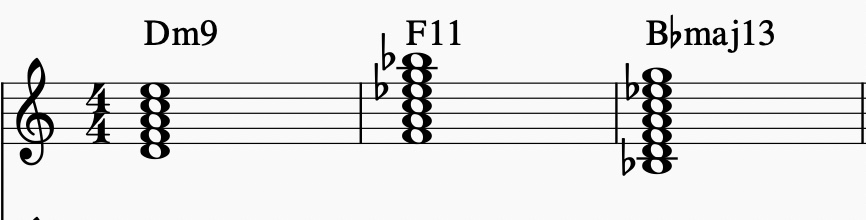
As you can see, a Bbmaj13 contains a great deal of notes, resulting in even more possibilities for voicings.
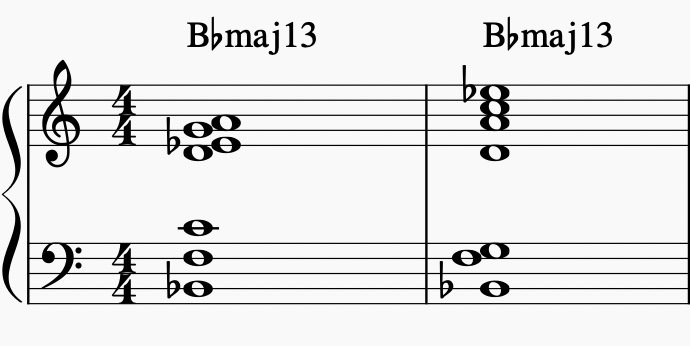
Remember, the G being the 13th of Bb does not mean it must be placed exactly a 13th above the root. For example, in the second voicing shown above, Bb and G are within the same octave. Feel free to put it in any octave. This rule applies to all extensions above the root note.
Non-diatonic Extensions
You may have noticed that the 9, 11 and 13 chords in the previous section contained notes that were all within one key. For example, A Bbmaj13 contains all seven notes in the Bb major scale. However, it is also common to extend chords with non-diatonic notes. These are always explicitly highlighted in the chord symbol, resulting in a quick learning process. Let’s go through a few examples:
C7b9 – a C7 chord with the addition of a flattened 9th (Db): C E G Bb Db.
C7b9#9 – a C7 chord with the addition of both a flattened 9th (Db) and sharpened 9th (Eb): C E G Bb Db D#.
Cmaj9#11 – a Cmaj9 chord with the addition of a sharpened 11th (F#): C E G B D F#.
C13#11 – A C13 chord, but replace the natural 11th (F) with a sharpened 11th (F#): C E G Bb D F# A.
C7b13 – A C9 chord with the addition of a flattened 13th (Ab): C E G Bb Ab
However, what is the difference between a C7b13 and a C7#5? The reason this is an important question to ask is because a b13 (Ab) and a #5 (G#) are the same note. Put simply, in a C7b13 you keep the 5th (G) and also add the b13 (Ab). In a C7#5, you replace the 5th (G) with the sharpened version of itself (G#), resulting in a four note chord: C E G# Bb (also known as Aug7).
Step 3 – A Few More Chords
There are some additional common chords that need to be addressed, but not to worry, they’re not complicated.
Most will know that in a sus2 chord, we replace the third with a the major 2. For example, a Csus2 is spelt C D G. Furthermore, in a sus4 chord, we replace the third with the major 4. For example, a Csus4 chord is spelt C F G. However, leading on from something previously discussed, what notes make up a Cadd9 chord? This is a C major triad with the addition of the 9th (D). C E G D. If you come across any ‘add’ note in a chord, you only need to focus on adding the one note.
You will often see chords like C7sus. If you see the word ‘sus’, note this implies the sus4, not the sus2. Therefore, a C7sus is spelt C F G Bb.
You will also come across 6 chords, for example, C6 or Cm6. This implies a triad with the addition of a major 6th. A C6 is spelt C E G A and a Cm6 is spelt C Eb G A.
Recap
At this point you are most likely thinking “that’s a lot of chords”. You are correct, however you will be surprised how quickly you can to learn them if you consistently test yourself. To help with this learning process, feel free to utilise the image below, highlighting all of the common chords you’ll find in jazz based on the root note C. Remember, make sure to experiment with voicings as the chords displayed below are merely highlighting the necessary notes. Alternate voicings can lift a chord to another sound dimension. Of course, there are a multitude of other chords in existence that are not shown, but if you use the tools learnt reading this article you will have no issues working through them.
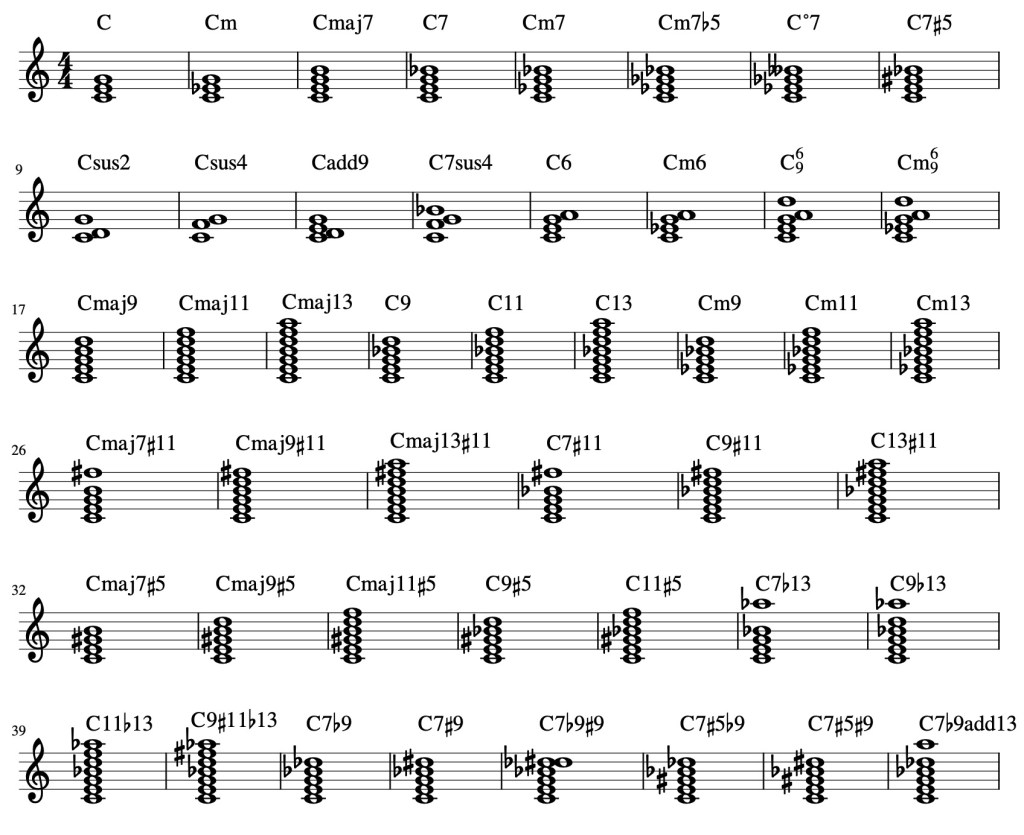
The next article in this Jazz Harmony series will be discussing the construction of jazz chord progressions. This will help put these chords in context as we analyse some typical pieces.
As a final tip, the best way to practice jazz harmony is to play through as much repertoire as possible. If you don’t already have one, get yourself the ‘Real Book’ (6th Edition). This is the holy grail for jazz sheet music and contains 400 tunes in the form of lead sheets. Lead sheets are a form of sheet music that contain the necessary melody and chord symbols required to play a piece.
As a final test, how would you construct these chords: Cmaj7 – C#dim7 – Dm9 – G7#5? Play the progression through on your piano or guitar and see if it matches the recording below.
 Music Omnibus