Intervals can be a fiddly topic to get your head around. At Grade 5 theory, you are expected to answer interval questions that are purposefully deceptive. If you learn this topic incorrectly, you will find yourself in a never-ending whirlpool of confusion. I have created this guide to put an end to confusion for musicians everywhere.
Prerequisite – Before tackling intervals, you must have a confident grasp of all major scales. Don’t even think about reading on unless you have this knowledge. And yes, I mean all twelve but preferably thirteen as both Gb major and F# major are equally common keys. If you’re feeling adventurous, learn Cb major as the alternative to B major and C# major as the alternative to Db major.
The Basics
Three important points before we get in to the juicy stuff:
- All intervals can be determined from a major scale.
- There are two parts to an interval: the distance and the type.
- All intervals should be calculated from the lowest note.
An interval is defined as the distance between two notes. An interval written out will read something like: major 2nd, perfect 5th, diminished 6th. Understanding the latter part, or the number, is the first (and hopefully simple) step. It defines the distance between two note names. For example:
C to C = 1st (unison)
A to C = 3rd
F to C = 5th
Even where sharps and/or flats are involved, you can disregard them for this step. For example:
C to C# = 1st (unison)
Ab to C# = 3rd
Fb to Cb = 5th
By understanding this, you are already half the way there! However, it is the former part of an interval, or the type, that often causes confusion.
Types of Intervals
Step 1: The Major Scale
There are five types of intervals: 1. Perfect 2. Major 3. Minor 4. Diminished 5. Augmented.
Perfect and major intervals are derived from the major scale. The other three are derived from alterations of the major scale.
The visual below shows each note of a C major scale as an interval above the note C.

The 4th, 5th and 8th (and 1st) notes of a major scale are described as perfect.
The 2nd, 3rd, 6th and 7th notes of a major scale are described as major.
At this stage it is important to note that intervals can be described as palindromes. Their descriptions are the same moving up or down. C up to G and G down to C are the same interval of a perfect 5th. Remember, we will be calculating all intervals from the lowest note, not because it makes a difference, but because it is indisputably simpler.
All major scales are constructed using the same formula (tone-tone-semitone-tone-tone-tone-semitone), hence all interval names within all major scales remain identical. Below is a visual that shows each note of a D major scale as an interval above the note D. Notice the construction and interval names are homogeneous.

With this information, it is now time to answer our first interval question.
Q1. What is this interval?

- Ascertain the two notes: F# and A.
- The lowest note is A, therefore we will use the A major scale.
- An A major scale has the following notes: A B C# D E F# G#.
- F# is the 6th note of an A major scale.
- Answer: Major 6th
Step 2: Altering the Major Scale
We will now learn how to calculate intervals where the upper note is not part of the lower note’s major scale. This is where we find minor, diminished and augmented intervals. To achieve this, learn the following phrases:
- A perfect interval made larger by a semitone becomes augmented.
- A perfect interval made smaller by a semitone becomes diminished.
- A major interval made larger by a semitone becomes augmented.
- A major interval made smaller by a semitone becomes minor.
You can then use logical reversal to account for other possibilities. For example, an augmented interval made smaller by a semitone must become a perfect interval, and so on…
These four sentences will allow you to answer the majority of complex interval questions. Let’s learn whilst we practice a few questions:
Q2. What is this interval?
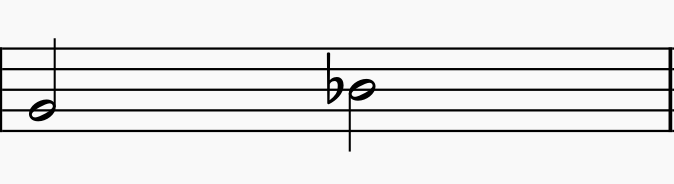
- Ascertain the two notes: G and Bb.
- The lowest note is G, therefore we will use the G major scale.
- A G major scale has the following notes: G A B C D E F#.
- Bb does not exist in a G major scale, but B does and is the 3rd note.
- Therefore, G to B is an interval of a major third.
- By flattening the B, we are making a major interval smaller by a semitone.
- Answer: Minor 3rd.
Q3. What is this interval?
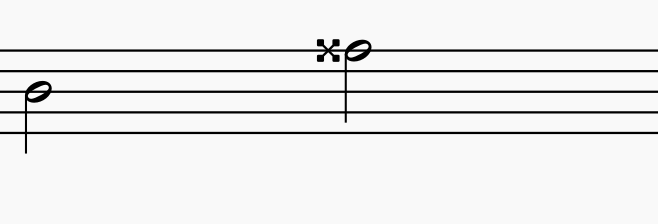
- Ascertain the two notes: B and F(double)#.
- The lowest note is B, therefore we will use the B major scale.
- A B major scale has the following notes: B C# D# E F# G# A#
- F(double)# does not exist in a B major scale, but F# does and is the 5th note.
- Therefore, B to F# is an interval of a perfect 5th
- By sharpening the F#, we are making a perfect interval larger by a semitone.
- Answer: Augmented 5th.
Step 3: Adjusting for Complications
Occasionally, you will be asked a question like this:
Q4. What is this interval?
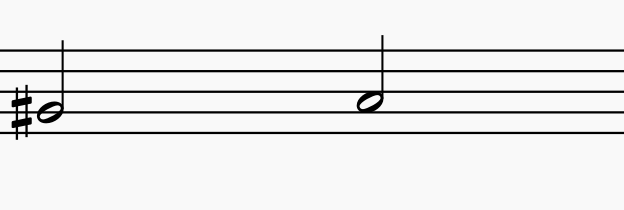
Our lowest note in this question is a G sharp. Naturally, most won’t be familiar with a G# major scale, as we almost never see this in music. To account for this complication, we will apply the following method:
- Remove the accidental from the lowest note to create a more palatable scale.
- This creates an interval of the notes G and A.
- An G major scale has the following notes: G A B C D E F#.
- An A does exist in a G major scale and is the third note.
- Therefore, G to A is an interval of a major 2nd.
- By sharpening the G, we are making the major interval smaller by a semitone (remember that old chestnut).
- Answer: Minor 2nd
This is precisely why the four sentences from before refer to intervals becoming smaller or larger, as opposed to being raised or lowered by a semitone. If we were to flatten the lower note, this would make the interval larger. This logic will never fail you and will allow you to answer the most complex interval questions any exam can throw at you.
Additional Information
One thing I must mention is what happens as an interval expands beyond the octave.
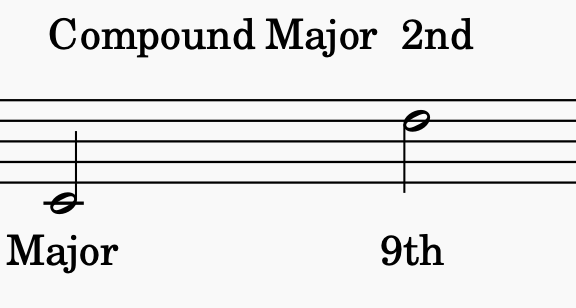
The interval above is a C to D plus one octave. There are two options for answering this question. The first is to put the word ‘compound’ in front of your normal interval name. The number of octaves being spanned is irrelevant. If the lowest note is C and the highest is D, the interval is a major 2nd. If these notes aren’t part of the same octave, we call it a compound major 2nd.
The second option, which isn’t my preferred method, is to continue counting above the octave. This means the number of interval will change, but fear not, the type of interval remains the same. This means that C to D plus one octave could be referred to as a major 9th, as D is the 9th note of a C major scale. When using this method, the number of octaves being spanned remains relevant. C to D plus two octaves is a major 16th.
The Common Mistake
The number one, worst, mistake I see people make is calculating intervals purely by semitones. If you search on Google for “what is a major 2nd in music?” the first sentence, both on the AI overview and the first three websites (all of which specialise in music theory), is:

There is nothing incorrect about this sentence, but it is incredibly misleading for those learning about intervals. C to D, as an interval, is a major 2nd and the distance between these two notes can also be described as two semitones. However, C to Ebb (E double flat) is a diminished 3rd and can also be described as two semitones! Do you see the issue here? Understanding the semitone makeup of intervals can be useful, but should never be the initial calculation. This can lead you down a very dark path of confusion.
Final Thoughts
Intervals are not an easy topic to learn; there are a few key prerequisites before you can have a crack at them. Once the correct methodology is acquired, follow my simple step-by-step process and you will find the correct answer.
If you’re interested in practicing ABRSM Grade 5 Theory interval questions, and the rest of the topics that feature in the exam, have a go at this practice test -> https://mymusictheory.com/music-theory-quizzes/grade-5-music-theory-test/.
 Music Omnibus