A cadence is a musical ending — a combination of chords that brings a phrase, section, or piece of music to a close. It provides a sense of rest, pause, or conclusion, similar to punctuation in written language. They help define the structure and phrasing of a piece by creating points of closure or continuation. They can sound final and resolved, or open and unfinished, depending on the chord relationship and context.
The prerequisite for this question is that you can list chords I, II, IV and V in any major or minor key.
There are three cadences you need to know for Grade 5 Theory:
Perfect (V – I)
Plagal (IV – I)
Imperfect (* – V) * can be replaced by chord I, II or IV
Here is a passage of music in the key of C major which uses all three types of cadences.

In the Grade 5 Theory exam, there are 3 types of questions that you will need to answer.
QUESTION 1

In the first question we need to identify suitable chords based on a melody line. This question has the largest margin for error so it’s important to follow a step-by-step process.
Step 1: Identify the key and list chords I, II, IV and V.
Key = D Major
I = D F# A (D major)
II = E G B (E minor)
IV = G B D (G major)
V = A C# E (A major)
Step 2: Identify the chord that best fits with the melody line, ensuring that the cadences are either Perfect, Plagal or Imperfect.
Chord A – The melody notes are G B D. This matches perfectly with chord IV.
Chord B – The melody notes are F# A. This must be chord I, which forms a plagal cadence.
Chord C – The melody notes are E F# G E – This best matches chord II.
Chord D – The melody notes are F# A D – This matches perfectly with chord I.
Chord E – The melody note is C#. This must be chord V, which forms an imperfect cadence.
Step 3: Answer
A = IV B = I C = II D = I E = V
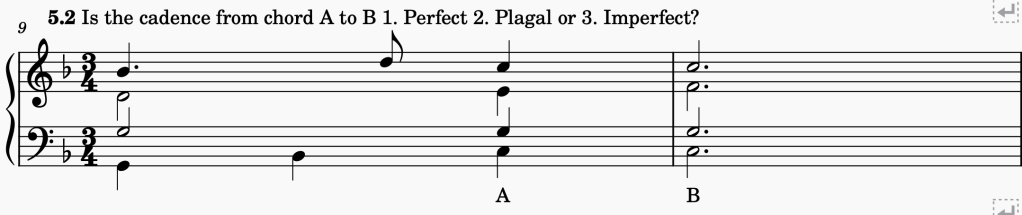
In this question we need to identify the cadence based on a passage of music (typically closed SATB).
Step 1: List chords I, II, IV and V in the respective key (which is provided)
I = F A C (F major)
II = G Bb D (G minor)
IV = Bb D F (Bb major)
V = C E G (C major)
Step 2: Work out the notes of the chords listed and their respective number in the key (I, II, IV or V)
Chord A – The notes (from lowest to highest) are C G E C. This matches chord V in the key of F major.
Chord B – The notes (from lowest to highest) are F A F C. This matches chord I in the key of F major.
Step 3: Answer
The cadence is a movement from chord V – I. This is a perfect cadence.
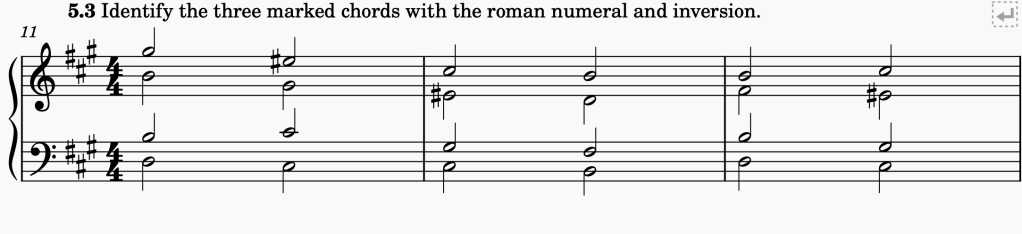
In this question we need to identify individual chords by their roman numeral and inversion within a passage of music (typically closed SATB).
In ABRSM, inversions are written with letters a b or c.
a = root position (C E G)
b = first inversion (E G C)
c = second inversion (G C E)
Step 1: List chords I, II, IV or V in the key. In this case we are told the key is F# minor.
I = F# A C# (F# minor)
II = G# B D (G diminished)
IV = B D F# (B minor)
V = C# E# G# (C# major*) *the V chord can be major or minor in a minor key. In general, it is typically major due to the raised 7th in harmonic minor.
Step 2: Work out the notes of the chords listed and their respective number / inversion in the key (I, II, IV or V AND a, b or c)
Chord A – The notes (from lowest to highest) are D B B G#. This is chord IIc in the key of F# minor.
Chord B – The notes (from lowest to highest) are C# G# E# C#. This is chord Va in the key of F# minor.
Chord C – The notes (from lowest to highest) are D B F# B. This is chord IVb in the key of F# minor.
Step 3: Answer
Chord A is IIc.
Chord B is Va.
Chord C is IVb.
 Music Omnibus